
1973–1987 GM Squarebody Engine Specs & Firing Order
Authoritative powertrain specifications for 1973–1987 Chevrolet C/K and GMC pickups. Inspect factory bore and stroke dimensions, cylinder head casting identification, valve sizes, and cylinder firing order rotation.
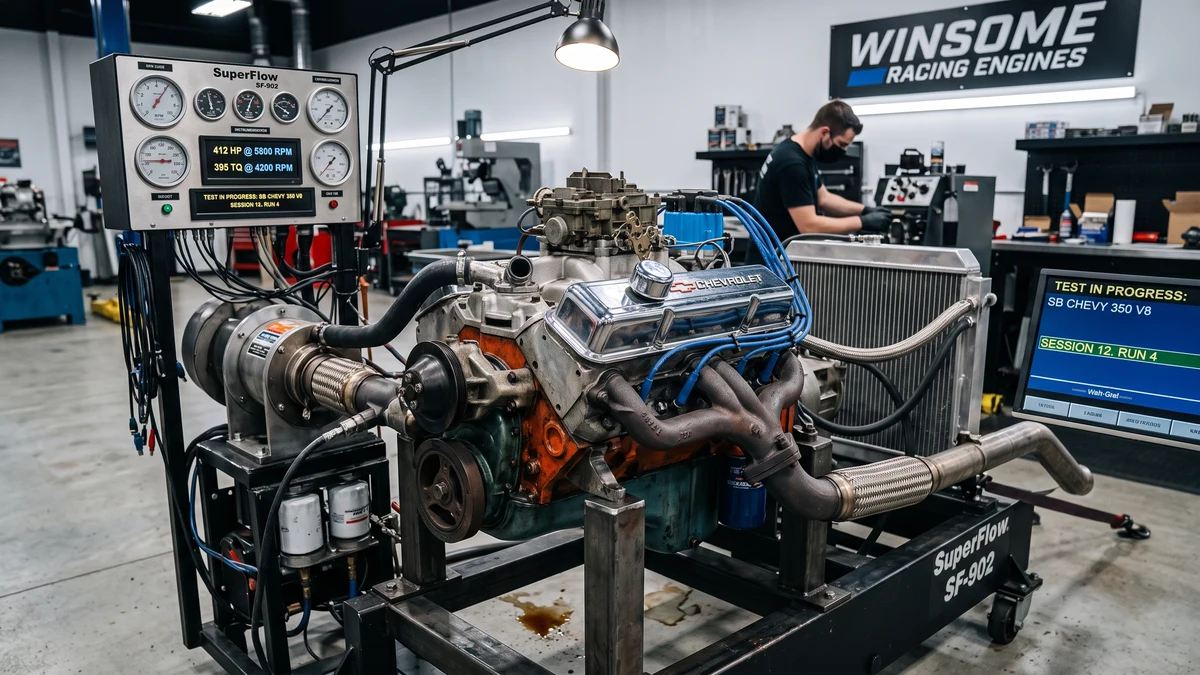
Interactive Powertrain Architecture & Cylinder Firing Sequence
Select an authentic GM powertrain to inspect internal dimensions, head casting numbers, valve sizes, and step through the dynamic cylinder firing sequence.
1973–1987 Squarebody Powertrain Lineup & Master Dimension Matrix
| Engine Family | Displacement | Bore × Stroke | Standard Induction | Gross / Net Output | Oil Pan Sump Spec |
|---|---|---|---|---|---|
| 250 Inline-6 | 250 cid (4.1L) | 3.875" × 3.530" | Rochester Monojet 1-bbl | 100–110 hp / 175 lb-ft | 5.0 Qts w/ filter (10W-30) |
| 292 HD Inline-6 | 292 cid (4.8L) | 3.875" × 4.125" | Rochester Monojet 1-bbl | 120–130 hp / 225 lb-ft | 6.0 Qts w/ filter (10W-30) |
| 305 Small Block | 305 cid (5.0L) | 3.736" × 3.480" | Rochester 2GC / Quadrajet | 130–160 hp / 240 lb-ft | 5.0 Qts w/ filter (10W-30) |
| 350 Small Block Sec 6A, p. 12GM Engine Manual ST-330SBC 350 Sump & Bore Spec 5.0 Qts w/ Delco Filter | 350 cid (5.7L) | 4.000" × 3.480" | Rochester Quadrajet 4-bbl / TBI | 160–210 hp / 300 lb-ft | 5.0 Qts w/ filter (10W-30) |
| 400 Small Block | 400 cid (6.6L) | 4.125" × 3.750" | Rochester Quadrajet 4-bbl | 175–185 hp / 300 lb-ft | 5.0 Qts w/ filter (10W-30) |
| 454 Big Block Sec 6B, p. 18GM Engine Manual ST-330BBC 454 Sump & Bore Spec 6.0 Qts w/ Delco Filter | 454 cid (7.4L) | 4.250" × 4.000" | Rochester Quadrajet 4-bbl / TBI | 210–245 hp / 385 lb-ft | 6.0 Qts w/ filter (15W-40) |
| 6.2L Detroit Diesel Sec 6C, p. 24GM Diesel Manual ST-3306.2L IDI Sump Spec 7.0 Qts 15W-40 Heavy Duty | 379 cid (6.2L) | 3.980" × 3.800" | Stanadyne DB2 Mechanical IDI | 135–150 hp / 240 lb-ft | 7.0 Qts w/ filter (15W-40) |
Selecting appropriate carburetor sizing for these powerplants is critical to prevent hesitation and bogging. Calculate exact airflow requirements with our Carburetor CFM Solver, and verify critical head and rod fastener torques in the Master Torque Specs Engine.
Small Block & Big Block Firing Order (1-8-4-3-6-5-7-2) & Clocking
Correct distributor orientation and spark plug wire routing are essential to prevent cross-firing and timing backfires:
Cylinder Bank Numbering
Standing at the front bumper looking rearward into the engine bay, the Driver Side (Left Bank) contains odd-numbered cylinders: #1 (front), #3, #5, and #7 (rear). The Passenger Side (Right Bank) contains even-numbered cylinders: #2 (front), #4, #6, and #8 (rear). Cylinder #1 is always the forward-most cylinder because the driver side connecting rod journals are positioned forward of the passenger side journals on the crankshaft.
Delco HEI Distributor Clocking
The Delco High Energy Ignition (HEI) distributor sits at the rear of the engine block. When the #1 piston is positioned at Top Dead Center (TDC) on its compression stroke with the crankshaft vibration damper timing mark aligned at 0° TDC on the timing tab, the distributor rotor must point toward the driver side front corner of the distributor body. Wire #1 is installed at this post, followed clockwise by 8, 4, 3, 6, 5, 7, and 2. See our Delco HEI 4-Pin Schematics for internal module pinouts.
Cross-Fire Prevention (Wires #5 and #7)
Notice that cylinders #5 and #7 fire consecutively in the sequence (1-8-4-3-6-5-7-2) and are physically adjacent to each other on the driver side bank. Keep the spark plug wires for #5 and #7 separated inside plastic factory wire loom separators to prevent magnetic induction cross-firing that causes severe engine knock under load.
Historic Engine Block & Cylinder Head Casting Identifiers
Casting numbers are raised alphanumeric digits cast into the iron during foundry pouring:
The Legendary #3970010 Block
The most famous casting in Small Block Chevrolet history, #3970010 was cast from 1969 through 1979 in both 2-bolt and 4-bolt main bearing cap configurations. Known for high nickel and tin alloy content, this 4.000-inch bore block is the premier foundation for 350 builds.
#14010207 & #14088548 Crate Blocks
Found in late 1980–1986 C/K trucks, these blocks incorporate 2-piece rear main seals, mechanical fuel pump bosses, and passenger-side oil dipstick tubes.
#3999289 454 Big Block
The heavy-duty Mark IV 454 block cast from 1971 to 1978 for C30 trucks and Suburbans, engineered with 4-bolt main caps and standard 4.250-inch bores.
Cylinder Head Castings
High-volume factory truck heads include casting #333882 (76cc open chamber, 1.94"/1.50" valves, 1974–1980) and #462624 (smog era lightweight casting, highly prone to exhaust seat cracking). Late 1987 TBI trucks used #14102193 "swirl-port" high-velocity intake heads optimized for low-RPM torque.
454 Big Block Mark IV vs 400 Small Block: Heavy Towing Dynamics
Understanding the mechanical tradeoffs between these engines is crucial when planning gear ratios and cooling upgrades:
400 cid Small Block (Siamese Bores)
GM achieved 400 cubic inches inside a standard Small Block envelope by casting a large 4.125" bore and 3.750" stroke. To fit the huge bores within 4.400" bore centers, GM siamesed the cylinder walls together, eliminating water jackets between cylinders. To prevent hot spots, steam holes were drilled between the cylinders. Equipped with shorter 5.565-inch connecting rods, the 400 produces incredible low-end torque but generates intense cylinder wall heat under sustained towing.
454 cid Big Block (Mark IV Brute Force)
The Mark IV Big Block weighs approximately 150 pounds more than a Small Block but provides massive 4.840" bore centers, full water jackets around every cylinder, and generous 6.135" forged steel connecting rods. Factory "peanut port" heads (#346236 or #353049) prioritize port velocity below 3,500 RPM, producing an effortless 385 lb-ft of torque at just 2,400 RPM.
6.2L Detroit Diesel (RPO LH6 & LL4) Factory Service Specs
Proper maintenance keeps the 6.2L running beyond 300,000 miles:
Fuel Injection System
Uses a purely mechanical Stanadyne DB2 rotary distributor-type fuel injection pump driven off the camshaft at half engine speed. Injector pop pressure is calibrated to 1,800 PSI.
Glow Plug Controller Circuit
Cold starting depends on 8 individual 12V pencil-type glow plugs. Early 1982–1984 trucks used fragile 9G AC Delco glow plugs that swell and break off inside the pre-combustion chamber when failing. Always retrofit to modern self-regulating AC Delco 60G glow plugs.
Harmonic Balancer Inspection
The 6.2L utilizes an externally balanced rotating assembly. If the rubber vulcanization ring on the front crankshaft harmonic balancer dries out and separates, severe torsional vibrations will snap the front crankshaft snout or crack the main bearing webs in the crankcase.
01 What is the firing order on a 1973–1987 Chevy Small Block 350?
The factory firing order for all 1973–1987 Chevrolet Small Block (305, 350, 400) and Big Block (454) V8 engines is 1-8-4-3-6-5-7-2. The distributor rotor turns clockwise. Looking at the engine from the front of the vehicle, the driver side cylinder bank contains odd cylinders (1-3-5-7) and the passenger side contains even cylinders (2-4-6-8).
02 Where is the engine block casting number located on a Chevy 350?
On all Chevrolet Small Block V8 engines (1973–1987), the 7- or 8-digit block casting number is raised (cast) on the driver side rear ledge of the engine block, directly behind the driver's side cylinder head and just above the transmission bellhousing flange. The iconic #3970010 casting denotes a 1969–1979 4.000-inch bore 350 cubic-inch block.
03 Why do Small Block 400 cylinder heads require steam holes?
The Chevrolet 400 cid Small Block features siamese cylinder bores with no coolant jackets between adjacent cylinders. To prevent steam pockets from forming between the hot cylinders, GM drilled 6 small steam holes through the engine block deck and cylinder head mating surfaces. When installing standard 350 cylinder heads onto a 400 block, steam holes must be drilled into the heads at a 30-degree angle.
04 How much oil does a Squarebody Chevy 350 hold?
A standard factory 1973–1987 Chevrolet C10/K10 350 Small Block V8 engine holds 5.0 US quarts (4.73 liters) of motor oil with a standard AC Delco PF25 or PF35 filter replacement. Heavy-duty 4x4 trucks equipped with the larger 1-quart PF35 filter hold a total of 5.0 to 5.5 quarts.
05 How do you set initial base timing on an HEI distributor?
To set base timing on a 1975–1986 Delco HEI distributor, warm the engine to operating temperature, disconnect and plug the vacuum advance hose at the distributor canister, connect an inductive timing light to spark plug wire #1, loosen the 9/16" distributor hold-down clamp, and rotate the housing until the timing mark aligns with factory specification (typically 8° to 12° BTDC). On 1987 TBI models, you must disconnect the single-wire tan/black EST bypass connector under the dash or near the firewall before checking timing.

Dave Miller, ASE Master Automobile Technician
Lead Technical Reviewer & Restoration Specialist • ASE Cert #A1-884210 • 26+ Years GM C/K ExperienceDave Miller is an ASE Master Certified Automobile Technician (#A1-884210, A1–A8 plus L1 Advanced Engine Performance) with 26 years specializing in third-generation General Motors C/K classic truck restorations, drivetrain ratio calculations, and chassis wiring diagnostics. Operating from his independent classic GM restoration workshop in Ohio, Dave maintains an active archival library of physical 1973–1987 GM Factory Service Manuals (ST-330, X-7832). Every torque specification, mathematical gear ratio calculation, and bulkhead pinout on SquarebodyTech is personally reviewed and verified against original GM engineering standards.
Squarebody Engineering Architecture & Technical Pipeline
Complete subsystem hierarchy modeling powertrain, drivetrain ratios, factory electrical, and Phase 2 sister tools.
Powertrain & Small/Big Block Engine Specs
CID, horsepower, compression ratios, firing order, and valvetrain tolerances for 250, 305, 350, 400, and 454.
Automatic & Manual Transmission Ratios
TH350, TH400, 700R4, and SM465 continuous highway RPM, gear ratio, and rolling tire diameter solver.
Universal 13/17-Digit VIN & SPID RPO Decoder
ISO 3779 dual-format decoder for model year, assembly plant, GVWR series, and factory options.
Factory Electrical & Bulkhead Wiring Pinouts
1973-1987 firewall bulkhead connector pinouts, GM color standards, wire gauges, and ignition circuits.