
1973–1987 GM Squarebody Models & Buyer's Guide
A forensic guide to purchasing and evaluating 1973–1987 Chevrolet C/K and GMC pickups. Inspect generational styling revisions, factory trim packages, critical steering box frame fatigue cracks, and authentic drivetrain specifications.
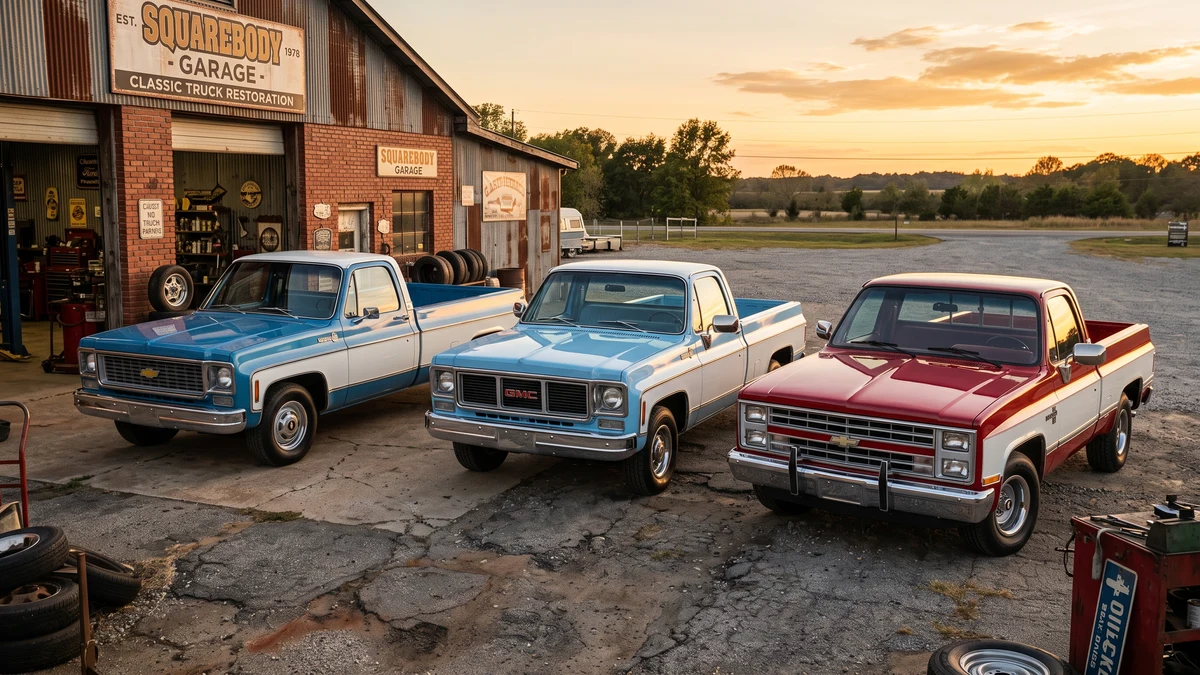
Squarebody Front Clip & Grille Visual Identifier
Instantly identify factory original front clips vs swapped aftermarket sheet metal across the 5 distinct GM production eras (1973 to 1987).
Year-by-Year Production Evolution (1973 to 1987)
When the "Rounded Line" debuted in the fall of 1972 for the 1973 production run, it introduced aerodynamic curved side glass, an integrated perimeter drip rail, and a wider track width that fundamentally modernized American light trucks. Evaluating a prospective purchase requires identifying original sheet metal configurations versus later swapped components:
1973–1974 (First Generation Round)
Equipped with single 7-inch round sealed beam headlamps mounted inside a recessed eggcrate grille. Front amber turn signals were integrated inside cutouts in the chrome front bumper rather than the grille. 1973 vehicles showcase unique one-year-only dashboard mounting tabs and windshield wiper linkages.
1975–1978 (Turn Signal Transition & Silverado Intro)
Front turn signals moved from the bumper into the radiator grille corners behind ribbed amber plastic lenses. 1975 introduced the prestigious Silverado badge, Delco High Energy Ignition (HEI) as standard equipment, and catalytic converters on half-ton trucks. Check out our HEI distributor wiring diagrams for full ignition schematics.
1979–1980 (Dual Headlight Packages)
Upper trim lines received optional stacked dual headlights (round in 1979, one-year-only rectangular in 1980). The Chevrolet bowtie emblem moved to the physical center of the grille mesh.
1981–1984 (Aerodynamic Redesign)
GM executed an extensive 200-pound front-end redesign with a forward-sloping hood, aerodynamically contoured front fenders, new front bumper with integrated air deflector, and dual or quad rectangular headlamps. Wiper controls migrated to the turn signal lever stalk.
1985–1986 (Split Grille & Refined Cockpit)
A heavy cast horizontal chrome center bar divided the upper and lower grille mesh. Introduction of Electronic Spark Control (ESC) on 305 LE9 V8 engines and newly contoured door panels.
1987 (R/V Designation & TBI EFI)
Pickups were rebadged R10/R20/R30 (2WD) and V10/V20/V30 (4WD). Carburetors were completely replaced with Rochester 2-barrel Throttle Body Injection (TBI), electric high-pressure in-tank fuel pumps, and dual-tank motorized switching valves. Verify fuel pump circuits via our Pollak 6-port tank valve schematics.
Factory Trim Level Hierarchy: Custom Deluxe to Silverado
| Trim Package | Years Offered | Exterior Distinction | Interior Specifications | Standard Instrument Cluster |
|---|---|---|---|---|
| Custom Deluxe | 1973–1987 | Painted steel bumpers, painted grille mesh, minimal body moldings | Full rubber floor mat, vinyl embossed bench, painted steel inner door tops | Standard warning lights (speedometer, fuel, oil/temp telltales) |
| Scottsdale | 1975–1987 | Bright chrome grille trim, chrome headlamp bezels, stainless mirrors | Patterned vinyl or woven cloth bench, bright dash trim accents, door map pockets | Optional full gauge package (volts, oil pressure, coolant temp) |
| Cheyenne / Super Cheyenne | 1973–1981 | Upper and lower bodyside protective moldings with black or woodgrain vinyl inserts | Full vinyl or nylon headliner, padded door armrests, woodgrain instrument cluster bezel | Full analog gauge cluster standard with illuminated dials |
| Silverado | 1975–1987 | Quad rectangular headlamps, brushed aluminum tailgate applique band, wheel lip trim | Full carpet floor, custom velour seat trim, carpeted lower door kicks, electric door locks | Deluxe analog gauge cluster with quartz electric clock |
Always cross-reference the body trim with the vehicle's VIN stamp. Decode your cab's assembly plant and series using our Squarebody VIN Decoder, and inspect factory structural sheet metal thickness in our Body Restoration Guide.
Critical Pre-Purchase Inspection: Steering Box Frame Horn Fatigue
On all 4x4 (K-series) and heavily loaded 2WD (C-series) frames, the Saginaw steering box mounts to the inside surface of the driver's side frame horn with three 7/16-inch grade 8 bolts. When turning larger-than-stock tires (33" or 35" flotation tires) or traversing rough terrain, immense torsional leverage twists the open C-channel frame rail back and forth.
Visual Crack Inspection
Clean the road grime off the driver's side frame rail directly behind the steering box. Look for hairline cracks radiating outward from the three mounting holes or along the top and bottom frame flanges. Have an assistant turn the steering wheel back and forth while the engine is running to observe frame rail flex.
Crossmember Rivet Shearing
Inspect the hot-riveted joints where the engine cradle and front crossmember connect to the frame horn. Loosened rivets allow the frame to twist independently of the crossmember, accelerating rail fatigue.
Approved Repair & Reinforcement Procedure
If cracks are present, the crack tips must be stop-drilled with a 1/8-inch bit, ground into a V-groove, and TIG/MIG welded with high-tensile wire. An aftermarket 3/16-inch cold-rolled steel weld-on frame reinforcement plate (such as ORD or DIY4x) must be welded to the outer frame rail, accompanied by a tubular bolt-in steering box brace connecting the lower steering box mounting bolts to the passenger side crossmember.
Cowl Drain Channels & Windshield Pinchweld
Pine needles and road debris accumulate inside the cowl drain cavity below the wiper motor, rusting through the inner firewall into the cab floor. Pour a cup of water into the wiper cowl; if water trickles behind the brake pedal or kick panels, the cowl seam is breached.
Drivetrain Selection Guide: Transmissions, Transfer Cases & Axles
Depending on the model year and weight rating, GM paired various engines and drivelines:
Automatic Transmissions
1973–1981 vehicles predominantly used the ultra-durable 3-speed Turbo Hydra-Matic 350 (TH350) or heavy-duty TH400. In 1982, GM introduced the 4-speed overdrive 700R4 (TH700-R4). Early 1982–1984 700R4 units incorporate 27-spline input shafts and fragile pump seals; 1985–1987 units incorporate upgraded 30-spline shafts and hardened sun shells. Calculate cruising RPM across all ratios using our Transmission RPM Calculator.
Manual Transmissions
The standard heavy-duty manual was the legendary Muncie SM465 4-speed, featuring a 6.55:1 ultra-low "granny" first gear and cast iron case.
Transfer Cases (4WD)
1973–1979 K-series trucks utilized the full-time cast-iron New Process NP203 (featuring a chain drive and center differential), or the bulletproof gear-driven all-cast-iron NP205. In 1981, GM transitioned to the lightweight aluminum chain-driven NP208 part-time transfer case with shift-on-the-fly capabilities.
Axle Strengths
Half-ton trucks utilized GM 10-bolt (8.5" ring gear) or early 12-bolt (8.875" ring gear) rear ends. 3/4-ton and 1-ton trucks were equipped with the legendary GM 14-bolt full-floating rear axle with a 10.5" ring gear and pinion support bearing. Verify torque values with our Torque Specs Engine.
01 What is the most desirable year for a GM Squarebody truck?
For collectors and classic builders, the 1973–1974 editions are highly sought after for their pure first-generation round headlight eggcrate grilles and embossed vinyl interiors. For daily drivability, 1987 is widely considered the pinnacle due to factory Rochester Throttle Body Injection (TBI) electronic fuel injection, high-pressure in-tank pumps, and ECM computer control.
02 Where do GM Squarebody truck frames commonly crack?
The primary structural failure point on 1973–1987 GM 4WD (K-series) and heavy 2WD truck frames is the driver's side front frame rail horn surrounding the Saginaw power steering gear box. Repeated torsional stress from larger tires and off-road articulation causes fatigue cracking around the three steering box mounting through-bolts and the front engine crossmember rivet holes.
03 What are the four GM Squarebody trim levels in order of prestige?
From entry-level fleet to premium top-tier, the 1975–1987 Chevrolet truck trim hierarchy was: (1) Custom Deluxe (work truck with rubber floor mats and painted bumpers), (2) Scottsdale (bright grille trim, instrument cluster accents, upgraded bench seat), (3) Cheyenne (woodgrain dash appliqués, full headliner, exterior chrome side moldings), and (4) Silverado (brushed aluminum tailgate band, velour or houndstooth seating, quad headlights, deep pile carpeting, and full door armrest pulls).
04 Why were 1987 Chevy trucks called R/V instead of C/K?
In 1987, General Motors reassigned truck model codes from C (2WD) and K (4WD) to R (2WD) and V (4WD) because GM was launching the all-new fourth-generation GMT400 platform for 1988, which took over the C/K designation. The classic Squarebody design continued production through 1987 for pickups (and through 1991 for Suburbans and Blazers) under the R/V model designation.
05 What is the difference between a C10 and a K10?
In GM nomenclature from 1973 to 1986, the letter 'C' designates two-wheel drive (4x2) with independent front coil spring A-arm suspension, while 'K' designates four-wheel drive (4x4) with a solid front axle (Dana 44 or GM 10-bolt) and semi-elliptical leaf springs. The number '10' denotes a 1/2-ton payload capacity ('20' for 3/4-ton, and '30' for 1-ton).

Dave Miller, ASE Master Automobile Technician
Lead Technical Reviewer & Restoration Specialist • ASE Cert #A1-884210 • 26+ Years GM C/K ExperienceDave Miller is an ASE Master Certified Automobile Technician (#A1-884210, A1–A8 plus L1 Advanced Engine Performance) with 26 years specializing in third-generation General Motors C/K classic truck restorations, drivetrain ratio calculations, and chassis wiring diagnostics. Operating from his independent classic GM restoration workshop in Ohio, Dave maintains an active archival library of physical 1973–1987 GM Factory Service Manuals (ST-330, X-7832). Every torque specification, mathematical gear ratio calculation, and bulkhead pinout on SquarebodyTech is personally reviewed and verified against original GM engineering standards.
Squarebody Engineering Architecture & Technical Pipeline
Complete subsystem hierarchy modeling powertrain, drivetrain ratios, factory electrical, and Phase 2 sister tools.
Powertrain & Small/Big Block Engine Specs
CID, horsepower, compression ratios, firing order, and valvetrain tolerances for 250, 305, 350, 400, and 454.
Automatic & Manual Transmission Ratios
TH350, TH400, 700R4, and SM465 continuous highway RPM, gear ratio, and rolling tire diameter solver.
Universal 13/17-Digit VIN & SPID RPO Decoder
ISO 3779 dual-format decoder for model year, assembly plant, GVWR series, and factory options.
Factory Electrical & Bulkhead Wiring Pinouts
1973-1987 firewall bulkhead connector pinouts, GM color standards, wire gauges, and ignition circuits.