
Squarebody Carburetor CFM Sizing & Airflow Calculator
Calculate exact airflow demand across GM Small Block, Big Block, and Inline-6 powertrains. Optimize CFM capacity for daily driving, heavy towing, or high-RPM drag strip applications.
Carburetor CFM Sizing & Airflow Requirement Solver
Calculate exact carburetor CFM capacity based on engine cubic inches, redline RPM, and volumetric efficiency (VE) to prevent low-end throttle bogging or top-end fuel starvation.
The Mathematical Physics of Internal Combustion Carburetor CFM Sizing
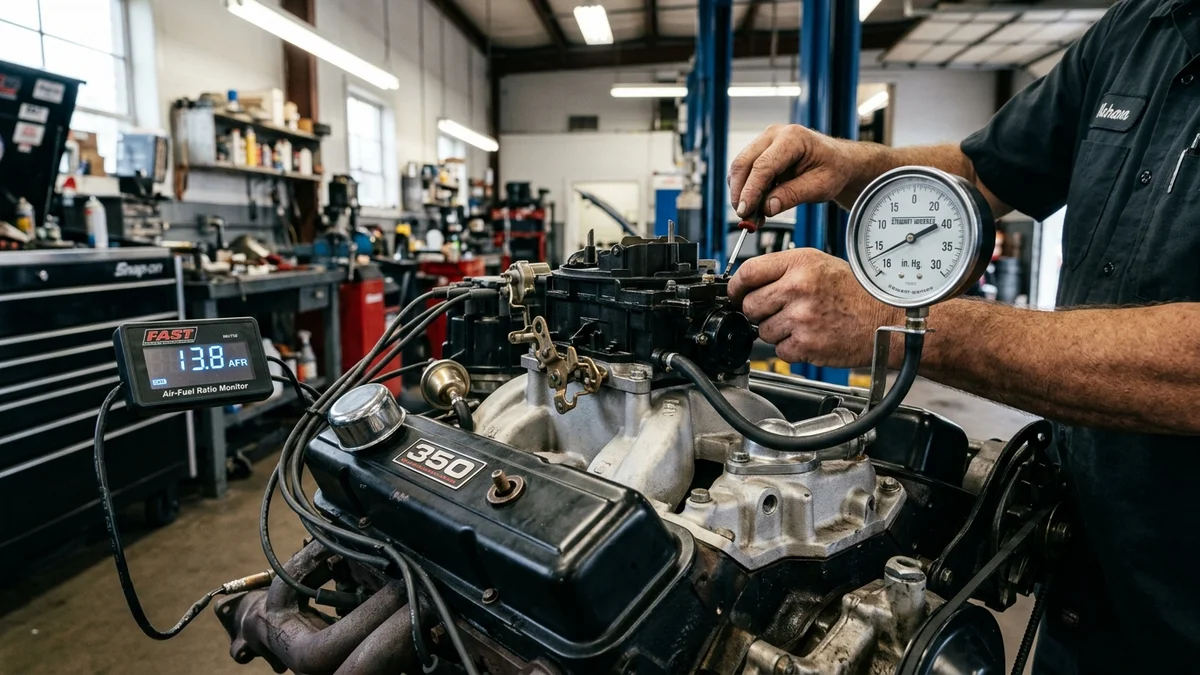
Selecting an oversized four-barrel carburetor is one of the most widespread mechanical mistakes made during classic Chevrolet and GMC truck restorations. A four-stroke internal combustion powerplant is fundamentally an atmospheric air pump. Its true intake capacity is strictly limited by cubic inch displacement (CID), peak operating crankshaft RPM, and the physical flow efficiency of the cylinder head intake ports and valvetrain.
The universal standard formula for four-stroke induction sizing derives mathematical cubic feet per minute from the following relationship:
The constant 3,456 represents the mathematical product of converting cubic inches to cubic feet (1,728) multiplied by 2, since each cylinder in a four-stroke cycle intake stroke occurs only once every two full crankshaft rotations. A stock factory Small Block 350 operating at 5,000 RPM at 80% volumetric efficiency draws precisely 405 CFM of air. Bolting an 850 CFM carburetor onto that engine reduces booster intake velocity by half, severely degrading fuel atomization and causing off-idle hesitation.
Rochester Quadrajet Spread-Bore vs Square-Bore Intake Dynamics
Many mechanics wonder why General Motors equipped modest 305-cid and 350-cid light-duty pickups with factory 750 CFM and 800 CFM Rochester Quadrajet carburetors from 1973 through 1986. The secret lies in the spread-bore design architecture. Unlike square-bore Holley or Edelbrock units with equal bore dimensions, the Quadrajet features tiny 1-3/8 inch primary throttles paired with cavernous 2-1/4 inch secondary air valves.
The miniature primaries create extreme venturi air velocity at low vehicle road speeds, drawing instant booster vacuum and atomizing fuel droplets thoroughly for smooth tip-in response and highway fuel economy. The massive secondary air valve is weighted by spring tension and manifold vacuum: it opens strictly on mechanical demand. If the engine only consumes 480 CFM at wide-open throttle, the secondary valve opens only halfway, preventing the dreaded vacuum drop and stumble typical of mechanical secondaries. Cross-reference torque values in our Master Torque Specs Guide.
Frequently Asked Questions About Carburetor Sizing
01 What is the standard formula for calculating carburetor CFM?
The universal automotive formula is: CFM = (CID × Max RPM / 3456) × Volumetric Efficiency (VE). A stock 350-cid Small Block turning 5,500 RPM at 85% VE requires (350 × 5500 / 3456) × 0.85 = 473 CFM.
02 Why did GM install 750 CFM Rochester Quadrajets on small 305 and 350 displacements?
The Quadrajet uses small primary bores (1-3/8 inch) for high intake air velocity and crisp low-RPM throttle response, coupled with a vacuum-actuated secondary air valve that only opens as much as the cylinder displacement demands, preventing bogging.
03 Can you put a 750 CFM mechanical double-pumper on a daily driver 350?
A mechanical secondary carburetor forces both primaries and secondaries open simultaneously regardless of manifold vacuum. On a mild street truck without high-stall converter and steep axle gears, floor-throttle launch drops vacuum to zero, causing severe bogging and sluggish acceleration.